
Hello!
Today I’m continuing my semester reflection (see the last post on my laboratory experiences here) to talk about one of my classes – Physics in the 20th Century (MIT 8.225) 😀
I needed to cross-register for an MIT class to stay in my MIT-affiliated apartment, so I chose this one! My friend convinced me to join her so that I could see her regularly, but she ended up skipping every lecture after the first week 😆 Regardless, it was very worth it; one of the best courses I’ve taken!
Well, except for one embarrassing moment… I was walking up the stairs after class, when my MGH badge got stuck in the aisle chairs, flinging me forward. I kept tripping up the stairs (not the typical direction, I know) until I slid into a row of chairs in the back of the room, spilling my coffee all over my white pants, hitting my chin on the chairs, and toppling the chairs over. It was super loud and embarrassing being an incompetent PhD student falling in an undergraduate classroom. I was so busy being embarrassed that I didn’t even notice the scrapes all over my hands. I am fine but uh LOL 😅
Anyways, the course starts with the history of Maxwellian physics (electricity and magnetism). In the late 1800s, those who studied modern-day physics, mathematics, and chemistry were all considered natural philosophers. Natural philosophers hypothesized that light travels through a medium called the luminiferous ether, until Einstein came along.
The infamous Albert Einstein, born in Germany 1879, actually dropped out of high school and failed his first university entrance exam. Once he eventually entered university, he skipped classes and annoyed his professors, so he couldn’t find a job afterwards. He ended up working at a patent office in Switzerland, where he submitted a few key papers to a big physics journal on the side:
- Light Quanta (March 1905)
- Brownian Motion (May 1905)
- Special Relativity (June 1905)
- E = mc^2 (September 1905)
Even if you’re not too familiar with the physics field, you may recognize some of these phenomena. Our first assignment was to write a paper critiquing Einstein’s famous paper on special relativity, which claimed that the controversial luminiferous ether is “superfluous.” The motivation for this assignment is brilliant – back in the day, these big journals didn’t have peer reviewers, so we got to be the peer reviewers that Einstein never had!
During the early 20th century, more prominent physicists began arising in Central Europe, including Niels Bohr, Arnold Sommerfeld, and Max Born. They began dominating the early stages of quantum physics, establishing their own scientific institutions and attracting many visiting scholars. The emergence of this scientific hub for quantum physics was the origin of America’s postdoctoral fellowships, so that its scientists can receive high quality training in other countries.
In the 1930s, the new Nazi laws barred non-Aryans from holding faculty positions in Germany, resulting in many scholars leaving the country, including Einstein, Born, and Schrodinger. Even the legal physicists, like Werner Heisenberg, were criticized by Nazi officials for continuing to teach things like relativity. But the Nazis realized that physicists could be useful for nuclear physics and appointed Heisenberg for the development of nuclear weapons in Germany.
During the Second World War, American physics revolved around nuclear physics as well, with Robert J. Oppenheimer leading the Manhattan Project that created the atomic bombs used to end the War. Realizing the detrimental effects of such a weapon and what might happen if their scientific knowledge reached the wrong hands, America became greatly concerned about security after the War. Oppenheimer, as well as other physicists, was suspected for ties to the Communist Party, and was consequently removed from national projects during the Cold War era.
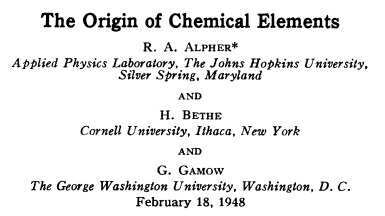
I did not particularly understand the rest of the class – the physics was beyond my understanding (quarks, QCD, cosmology, big bang theory, string theory, etc). But! A funny historical anecdote. In academic papers, the authors are usually listed in order of contribution, with the last author typically being the senior researcher or PI. Senior physicist George Gamow worked with Ralph Alpher on the big bang theory, and released a paper (shown below) on April Fool’s Day (1948). Without permission, Gamow included physicist Bethe in the list of authors, even though Bethe has nothing to do with this research. Why? To make the author list “Alpher, Bethe, Gamow!” What a clown!
I did not expect to find this class so useful and interesting. I learned a lot about the history of electricity and magnetism, which I can relay to my future MITES students (I teach E&M physics in the MITES Summer Program). I learned a lot about the history of academia as a whole and chatted with the professor about how history might inform the current funding crisis. The professor said that the current funding crisis is nowhere near as drastic as the 50% government funding cut in physics after the Second World War, but the field of physics rebounded shortly because of Cold War needs. I also got a glimpse into how different fields write their papers. Physics history papers use footnotes for references and are more permitting of first-person and argumentative presentation, while scientific papers cite (Author, year) and are usually a presentation of scientific data. My SHBT professors were also excited to hear about what I learned each week. I had a great time, and I’ll miss having such a low-stress but informative class.
Next post, I will share about my other class, From Sound to Neuron (SHBT 201). Thanks for reading, have a wonderful evening! 🙂
Citations
Albert Einstein, “On the electrodynamics of moving bodies,” translated and reprinted in Arthur I. Miller, Albert Einstein’s Special Theory of Relativity (Reading: Addison-Wesley, 1981), pp. 392-396.
Alpher, R. A., Bethe, H., & Gamow, G. (1948). “The Origin of Chemical Elements”. Physical Review, 73(7), 803–804. DOI: 10.1103/PhysRev.73.803.
David Kaiser, Lecture Slides for 8.225 / STS.042, MIT, 2025.


 The Zeeman Effect
Leave a reply to Woochun Cancel reply